



300+ clinicians, doctors, and dermatologists have shared Svens Island for eczema relief, with no compensation.
KEY TAKEAWAYS
- Eczema and psoriasis are both chronic inflammatory skin conditions, but they involve different immune pathways and have distinct characteristics
- Psoriasis is driven primarily by the Th17 immune pathway and causes well-defined, silvery-scaled plaques — most commonly on the elbows, knees, and scalp
- Eczema is driven primarily by the Th2 immune pathway, causes intense itch with dry, weeping, or crusted patches — and is strongly associated with Staphylococcus aureus (Staph bacteria) colonisation
- Location on the body is one of the most reliable ways to distinguish them: psoriasis favours extensor surfaces; eczema favours flexural areas in children, and the hands, face, and neck in adults
- Daily skin support (barrier repair, gentle anti-inflammatory, fragrance-free) benefits both conditions
Two Conditions That Are Easy to Confuse
Eczema and psoriasis are two of the most common inflammatory skin conditions in Australia. They're both chronic, both cause red and irritated skin, and both tend to flare and calm in cycles. It's not surprising that people confuse them — or spend years managing what they think is one condition while actually dealing with the other.
But they're distinct conditions. They involve different immune mechanisms, appear in different locations, look different on close inspection, and respond to different management approaches. Even choices like which body wash for psoriasis or eczema you use, and how you apply products after bathing, follow different logic for each. Understanding which one you're dealing with changes everything about how you approach it.
This article walks through the key differences — in plain language, without a GP visit required.
What Is Psoriasis?
Psoriasis is a chronic immune-mediated skin condition affecting around 2% and 6.6% of Australians. Unlike eczema, which is primarily driven by the Th2 immune pathway, psoriasis is driven largely by the Th17 immune axis — a different branch of immune activity that causes keratinocytes (skin cells) to proliferate at a dramatically accelerated rate.
In normal skin, skin cells are replaced roughly every 28 days. In psoriasis, that cycle can be as short as three to five days — meaning new skin cells pile up on the surface faster than old ones can shed. The result is the characteristic thick, scaly plaques that distinguish psoriasis from other skin conditions.
Psoriasis has a strong genetic component and is closely associated with systemic inflammation — people with psoriasis have elevated rates of cardiovascular disease, psoriatic arthritis, and metabolic syndrome. It's not just a skin condition. It's a systemic inflammatory disease that happens to be visible on the skin.
What Is Eczema?
Eczema — particularly atopic dermatitis, the most common form — affects around 1 in 5 Australian children and around 1 in 10 adults. It's driven primarily by the Th2 immune pathway, which leads to barrier dysfunction, intense itch, and heightened sensitivity to environmental triggers.
Eczema-prone skin has a structurally weaker outer barrier than normal skin — it loses moisture faster, allows irritants and allergens to penetrate more readily, and is more reactive to everyday triggers. This barrier weakness is often linked to mutations in the filaggrin gene, which produces a key structural protein for the skin's outer layer.
A compromised barrier also gives Staphylococcus aureus (Staph bacteria) a foothold. Staph is present on most eczema-prone skin and produces toxins that drive inflammation and itch — keeping the flare cycle going even after the original trigger is long gone. This bacterial component is one of the most important features of eczema that distinguishes it from psoriasis, and one that standard moisturisers don't address.
How to Tell Them Apart: The Key Differences
Location on the body
Psoriasis most commonly appears on extensor surfaces — the elbows, knees, lower back, and scalp. Nail involvement (pitting, thickening, separation) is common in psoriasis and rare in eczema. Psoriatic plaques can also appear on the palms and soles.
Eczema in children most commonly appears in flexural areas — the inner elbows, behind the knees, and the neck. In adults, eczema more commonly presents on the hands, face, eyelids, and neck. It rarely affects the scalp in the same way psoriasis does.

Appearance of the skin
Psoriasis produces well-defined, raised plaques with a characteristic silvery-white scale. The edges are sharp and clearly demarcated from surrounding skin. Plaques tend to be thicker and more uniform than eczema patches.
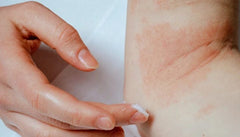
Eczema produces patches that are less clearly defined at the edges, with variable appearance — dry and scaly during calm periods, red and weepy during flares. Crusting can occur when Staph levels are elevated or during scratching.
Itch
Both conditions itch — but differently.
In eczema, itch is typically intense, relentless, and a defining feature of the condition. It peaks overnight, is closely linked to Staph activity on the skin, and drives the scratch-damage cycle that keeps flares going. The itch itself is one of the primary ways eczema disrupts daily life.
In psoriasis, itch is present but often less central than the scaling and the appearance of the plaques. Some people with psoriasis describe more burning or stinging than intense itch. That said, severity varies significantly between individuals.
Triggers
Psoriasis is commonly triggered by stress, illness (particularly streptococcal throat infections), certain medications (beta-blockers, lithium, antimalarials), skin injury, and alcohol. It is not driven by the same bacterial mechanism as eczema.
Eczema is triggered by irritants (soaps, detergents, fabrics), allergens, temperature changes, sweat, stress, and the Staph bacterial environment on the skin. Food allergens play a role in a subset of people, particularly children.
The overlap zone
Psoriasis and eczema can genuinely overlap — both clinically and in the same individual. Up to 50% of cases with palmoplantar (palm and sole) involvement are misdiagnosed when assessed by visual inspection alone. Some people carry atopic dermatitis as their baseline condition and also develop psoriasis. When presentations are ambiguous, a dermatologist — and occasionally a skin biopsy — may be needed for a definitive diagnosis.
Bathing and Skin Care: What to Use for Each
Both conditions respond to the same bathing fundamentals: lukewarm water rather than hot, brief baths or showers (ten minutes maximum), and soap-free fragrance-free cleansers. A good body wash for psoriasis or eczema-prone skin should be free from fragrance, sulphates, and harsh preservatives — all of which disrupt whatever barrier function remains.
For eczema, applying a barrier-supportive product immediately after bathing while the skin is still damp is essential — it seals in moisture before transepidermal water loss accelerates. A formula that also addresses Staph delivers more lasting benefit than a standard moisturiser.
For psoriasis, the focus after bathing is on hydrating the plaques to reduce scale and support the skin between treatment applications. Heavy emollients and moisturisers help keep psoriatic skin comfortable, though they don't address the underlying immune mechanism driving the condition.
The active treatment approach differs significantly. Psoriasis is managed with treatments targeting the Th17 pathway (topical vitamin D analogues, retinoids, biologics for severe cases). Eczema is managed with treatments targeting the Th2 pathway and the bacterial component — steroid creams for acute flares, and consistent daily barrier and Staph support between flares.
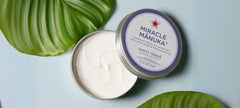
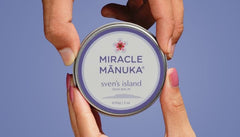
Where the two conditions share common ground is in daily skin support. Our Miracle Manuka Cream is formulated with Mānuka and Kānuka — botanicals that help calm itch and redness, reduce localised inflammation, and soothe irritated skin — alongside marshmallow root, which forms a protective layer over dry skin and helps lock in moisture. For eczema, it also fights Staph bacteria directly. For psoriasis, the anti-inflammatory and barrier-repair properties help soothe plaques and reduce discomfort between prescribed treatments. Steroid-free, fragrance-free, dermatologist-tested, and trusted by 150,000+ families. 95% of users noticed significant improvement after 2 weeks.
When to See a Doctor
Both conditions benefit from a confirmed diagnosis — particularly when:
- The presentation is atypical or ambiguous (especially on the hands, feet, or face)
- Over-the-counter management isn't producing improvement after four to six weeks
- The condition is covering large areas of the body
- Joint pain or stiffness accompanies the skin symptoms — this may indicate psoriatic arthritis, which requires specific treatment
- The skin shows signs of bacterial infection (honey-coloured crusting, pain, weeping, rapid worsening)
A GP can usually distinguish between eczema and psoriasis on clinical examination. If the presentation is unclear, a referral to a dermatologist — and occasionally a skin biopsy — provides a definitive answer.
What the Research Shows
Eczema and psoriasis share chronic inflammatory pathways but involve opposing immune mechanisms. Psoriasis is driven primarily by the IL-23/Th17 axis — leading to keratinocyte hyperproliferation and the characteristic scaly plaques — while atopic dermatitis is dominated by Th2 cytokines (IL-4 and IL-13) that impair barrier function and drive sensitisation.¹ This immunological opposition is one reason the two conditions respond to entirely different targeted therapies.
Research confirms that clinical differentiation can be genuinely difficult — particularly in atypical presentations. A 2023 molecular diagnostic study found that up to 50% of palmoplantar cases are misdiagnosed by visual inspection alone, reinforcing the value of a dermatologist assessment when the presentation is ambiguous.²
On the eczema side, the role of Staph bacteria is well-established. Research confirms Staph is present on 80–100% of eczema-prone skin compared to around 20% of normal skin, with colonisation density correlating directly with flare severity.³ No equivalent bacterial driver has been identified in psoriasis, which is primarily immune-mediated without the same bacterial component.
Both conditions carry significant quality-of-life burden — but through different mechanisms. Psoriasis is associated with systemic comorbidities including cardiovascular disease and psoriatic arthritis.⁴ Eczema's burden is more concentrated in sleep disruption, psychological impact, and the constant barrier-bacterial cycle that keeps flares recurring.⁵
Frequently Asked Questions
How do I know if I have eczema or psoriasis? Location and appearance are the most useful starting points. Psoriasis produces thick, silvery-scaled, sharply defined plaques — most commonly on the elbows, knees, scalp, and lower back. Eczema produces less defined, intensely itchy patches that tend to weep or crust during flares — most commonly in flexural areas in children, and on the hands, face, and neck in adults. If you're unsure, your GP can usually make a clinical assessment, and a dermatologist referral or skin biopsy can confirm ambiguous cases.
Can you have both eczema and psoriasis? Yes. Some people carry atopic dermatitis as their baseline condition and also develop psoriasis — the two can be active simultaneously. Presentations involving the hands and feet are particularly prone to diagnostic overlap. A dermatologist assessment is the most reliable way to distinguish them when both seem possible.
Is the body wash I use important for psoriasis and eczema? Yes — for both conditions. A good body wash for psoriasis or eczema-prone skin should be fragrance-free, sulphate-free, and free from preservatives that irritate sensitive skin. Standard soaps and many conventional body washes disrupt the skin's pH and strip the lipid layer, worsening both conditions.
A gentle, natural cleanser like Manuka Kiss Body Wash is an excellent starting point for both conditions, as it cleanses effectively without stripping the skin’s natural oils or disrupting the barrier.
Does scratching cause psoriasis to spread? Psoriasis can be triggered or worsened by skin injury — a phenomenon known as the Koebner response, where new plaques appear at sites of trauma. Scratching can trigger the Koebner response and worsen existing plaques. In eczema, scratching physically damages the skin barrier, increases Staph colonisation, and intensifies the flare cycle — the mechanism is different but the outcome is similar.
Is psoriasis related to eczema? They're related in the sense that both are chronic inflammatory skin conditions with genetic and immune components — but they involve opposing immune pathways and are distinct diseases. Having eczema doesn't increase your risk of developing psoriasis and vice versa, though both can occur in the same individual.
Final Thought
Knowing which condition you're managing is the foundation of managing it well. Eczema and psoriasis look similar enough to be confused — but their underlying mechanisms are different enough that the right approach for one is often not the right approach for the other.
For both, the daily skin care fundamentals are the same: fragrance-free, barrier-supportive, gentle. Where they diverge is in the active treatment. For eczema specifically, addressing Staph alongside barrier support is the piece most often missed by standard creams.
Try Sven's Island Miracle Manuka Cream for 60 days. If your skin doesn't improve, get your money back — no questions asked.
REFERENCES
¹ Schäbitz A, et al. (2021). So close, and yet so far away: The dichotomy of the specific immune response and inflammation in psoriasis and atopic dermatitis. Journal of Internal Medicine. https://consensus.app/papers/details/04d18d61a31558b68132eccb9ea91cda/
² Fischer F, et al. (2023). Gene expression based molecular test as diagnostic aid for the differential diagnosis of psoriasis and eczema. Journal of Investigative Dermatology. https://consensus.app/papers/details/4d336ddc6c73525fa949d73b4a4d9a68/
³ Totté JEE, et al. (2016). Prevalence and odds of Staphylococcus aureus carriage in atopic dermatitis: a systematic review and meta-analysis. British Journal of Dermatology, 175(4):687–695. https://pubmed.ncbi.nlm.nih.gov/26994362/
⁴ Rendon A, Schäkel K. (2019). Psoriasis Pathogenesis and Treatment. International Journal of Molecular Sciences. https://consensus.app/papers/details/0e7a85e9016e5ee7a0304f9bcdc848d4/
⁵ Weidinger S, et al. (2016). Atopic dermatitis. The Lancet, 387(10023):1109–1122. https://pubmed.ncbi.nlm.nih.gov/26377142/
Mentioned in this article
Works well with Eczema prone skin


- $52.80
-
- $52.80
- -0%
- Unit price
- per


- $49.60
-
- $49.60
- -0%
- Unit price
- per


- $79.20
-
$145.00 - $79.20
- -32%
- Unit price
- per


- $34.00
-
- $34.00
- -0%
- Unit price
- per


